Discover everything about the blue tit: from behavior to identification. Perfect for nature lovers who want to enjoy birds in 2027.
Anyone who has spotted a little bird with a bright blue crown, yellow breast, and lively movements in their garden has likely met the blue tit. This colorful bird is one of the most beloved garden residents in the Netherlands and embodies the wonder of nature unfolding right before our eyes. For many nature lovers who plan their year with a nature calendar or bird guide, the blue tit is a faithful companion through all the seasons. In this piece we dive into the fascinating world of this energetic bird, discover why the blue tit is so special, and learn how to best enjoy this blue-and-yellow wonder in 2027.
Recognizing the blue tit: a colorful portrait
The blue tit is unmistakable once you know what to look for. With its compact build of about 11–12 centimeters and a weight of only 10 grams, it is one of the smaller songbirds in our gardens. But what the blue tit lacks in size, it more than makes up for in character and color.
Distinctive colors and markings
The blue tit's color combination is simply spectacular:
Bright blue crown with white cheeks, framed by a dark blue line
Yellow underside that contrasts with the green back
White wing bars that become visible in flight
Dark stripe across the belly in males (less pronounced in females)
According to the British Trust for Ornithology, these color patterns are not only pleasing to the eye but also play a crucial role in communication between blue tits. Young birds are less colorful, with a yellow-green tint where adults have their characteristic blue crown.
Notable behavioral traits
The blue tit is an acrobat above all. You often see it hanging upside down from branches while searching for insects in the bark. This agility makes it uniquely suited to exploiting food sources other birds cannot reach.
Characteristic
Description
Best time to observe
Acrobatic behavior
Hangs upside down from branches
All year
Quick movements
Nervous, always on the move
Spring and summer
Flocking behavior
Social, often in mixed flocks
Autumn and winter
The blue tit through the seasons: an annual story
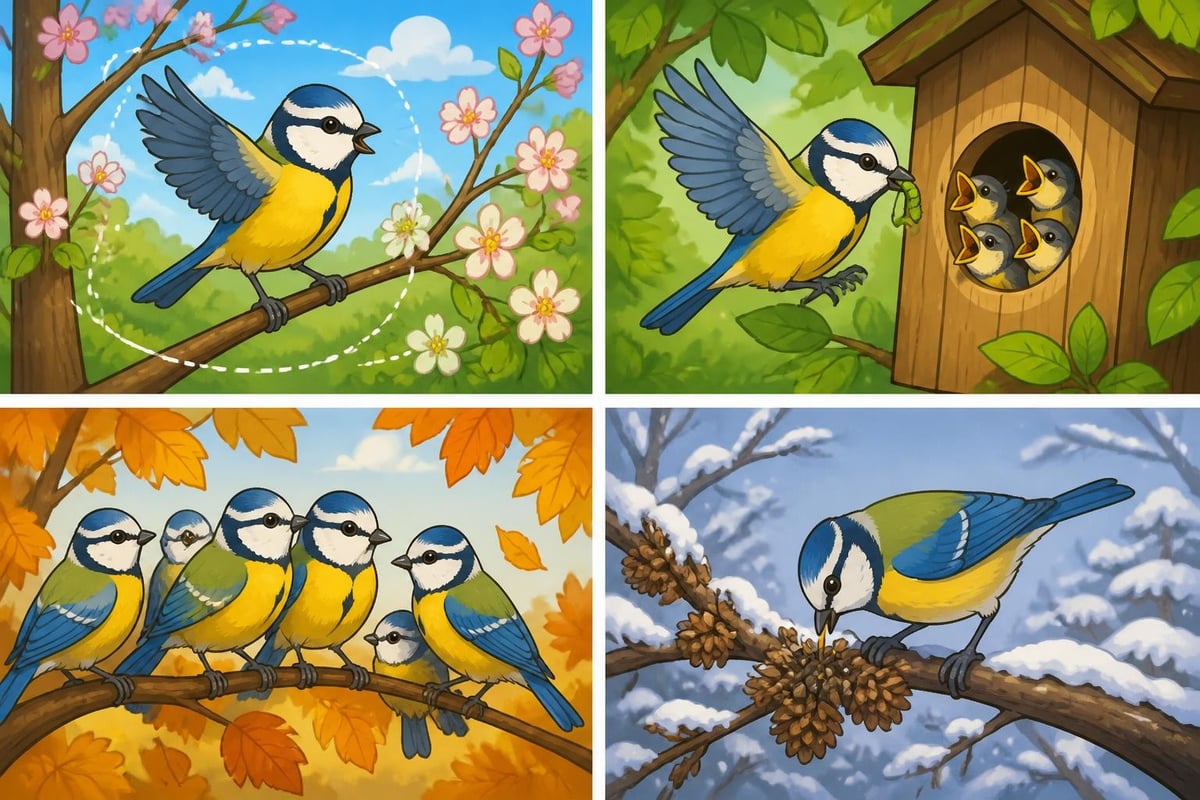
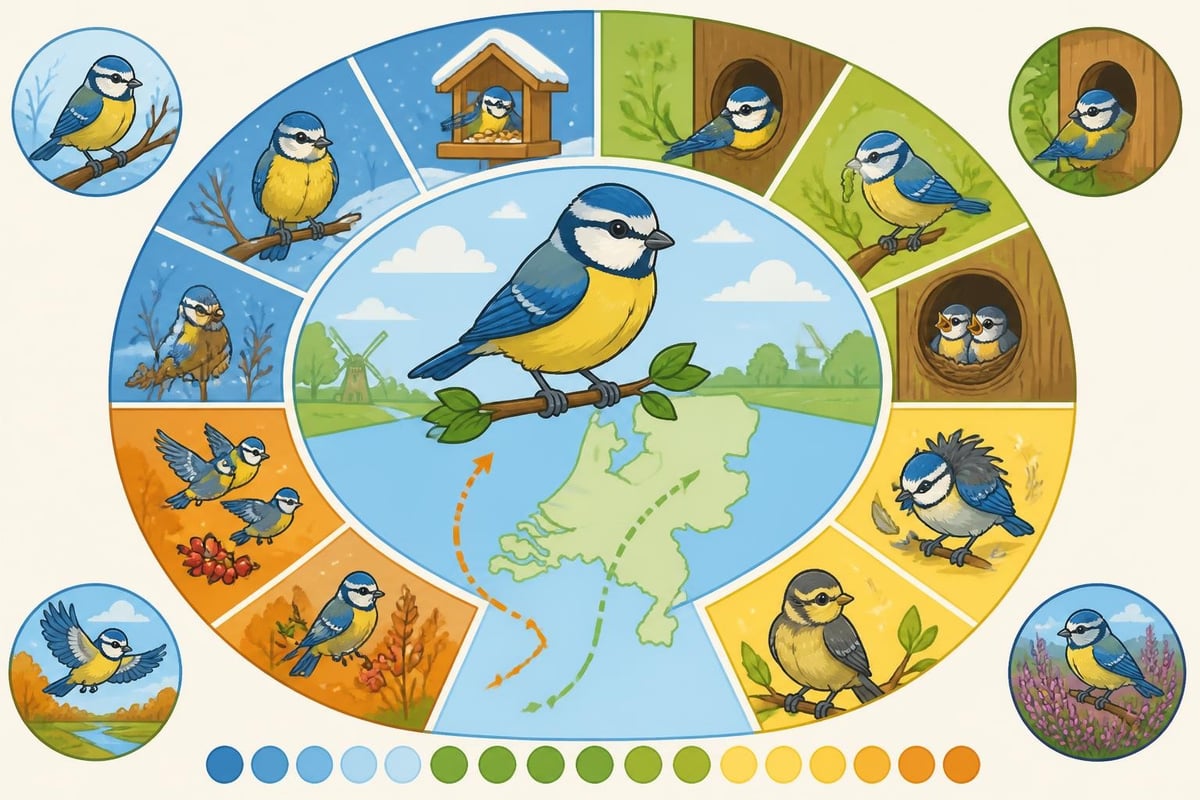
For anyone wanting to follow nature closely in 2027, the blue tit offers a fascinating story that unfolds season by season. Each time of year brings different behaviour and different observation opportunities.
Spring: the breeding season begins
From March male blue tits become territorial. Their bright, rolling song — a "tsi-tsi-tsi-tsirrrr" — rings out from high perches. This is when these birds claim nesting sites, preferably in old woodpecker holes or, as is often the case today, in nest boxes.
Nest building is almost exclusively the female’s work:
The female selects the location (often checked by the male)
She gathers moss, grass and hair for the nest
On average 8–12 eggs are laid in April
Incubation lasts about 14 days
Chicks stay in the nest for 18–21 days
The timing of this process is crucial. Research published in Nature shows that climate change disrupts the synchrony between blue tit hatching and the peak in caterpillar availability. This has direct consequences for breeding success.
Summer: the busy feeding season
June and July are the busiest months for blue tits. Parents make hundreds of flights per day with caterpillars, spiders and other insects for their hungry young. A single nest with twelve chicks can consume up to 10,000 caterpillars before the chicks fledge.
This intensive feeding behaviour makes the blue tit a valuable ally for gardeners. They naturally help control harmful insect populations.
Autumn and winter: social behaviour and survival
After the breeding season the blue tit’s behaviour changes significantly. They form mixed flocks with other tits, such as great tits and long-tailed tits. This flocking provides protection from predators and increases the chances of finding food sources.
In winter blue tits are happy guests at feeding stations. They prefer:
Sunflower seeds
Peanuts (unsalted)
Fat balls
Mealworms
Where can you find the blue tit in the Netherlands?
The blue tit is one of the most widespread birds in the Netherlands. According to SOVON, an estimated 800,000 to 1.2 million pairs breed in our country. This bird is not fussy about habitat, but it does have preferences.
Favorite habitats
Habitat type
Attractiveness
Reasons
Deciduous forests
Very high
Lots of insects, natural nesting opportunities
City parks
High
Nestboxes, feeders, varied planting
Gardens
High
Accessible food, nestboxes
Coniferous forests
Average
Less food availability during the breeding season
The blue tit especially favors areas with old oaks and beeches, where rough bark harbors many insects. But it also does very well in urban areas, as long as there is enough greenery and nesting opportunity.
Regional differences in the Netherlands
Although the blue tit is widespread, there are regional differences in density. In the south and east of the Netherlands, where there is more deciduous woodland, densities are higher than in the open polderland of the west. Urban areas with lots of green, such as Amsterdam's canal belt or the Haagse Bos, have surprisingly high densities.
For nature lovers who want to record their observations in 2027, a nature calendar is a handy tool to recognize patterns throughout the year.
The blue tit and scientific research
The blue tit is a favorite research subject for biologists worldwide. This is due to several factors: they are common, easy to observe, accept nestboxes, and have a short generation time. This makes them ideal for long-term studies.
Key research insights
Recent research has uncovered fascinating aspects of blue tit life. A study available via arXiv examined variation in egg composition among different populations. This work shows that mother birds adjust their eggs' composition to local conditions, giving chicks a better start.
Climate research reveals vulnerability:
Earlier spring leads to shifts in food peaks
Young blue tits can starve with poor timing
Some populations adapt faster than others
Flexibility in laying dates is crucial for future success
The BTO monitoring data from 2025 show that blue tit populations in the United Kingdom fluctuate depending on winter conditions and spring temperatures. These insights are also relevant to Dutch populations.
Ring study and life expectancy
Ring-recovery studies show that the average life expectancy of a blue tit in the wild is about 2–3 years. The oldest ringed blue tit, however, lived to 11 years, showing that some individuals can live remarkably long under favorable conditions.
The blue tit in the garden: how to lure it?
For many nature lovers having blue tits in the garden is a source of joy. Fortunately this bird is relatively easy to attract with the right provisions.
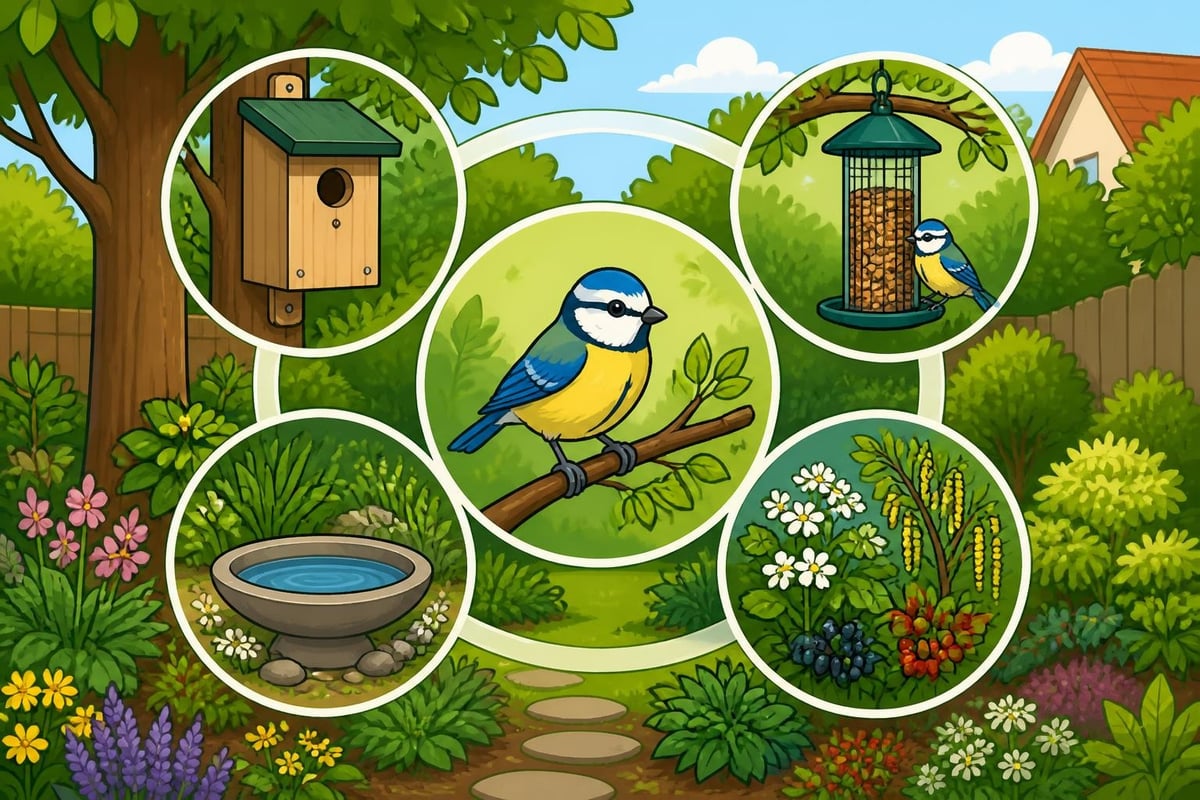
Essential elements for a blue-tit–friendly garden
Food through the seasons:
Spring: Let insects thrive, avoid pesticides
Summer: Plant diversity attracts caterpillars and flies
Autumn: Berries and seeds as supplements
Winter: Suet balls and sunflower seeds at feeders
A nest box is almost essential. The ideal nest box for a blue tit has an entrance hole of 28 millimeters (smaller than for great tits) and hangs 2–4 meters high in a sheltered, semi-shaded spot.
Water is crucial
An underrated element is water. Blue tits need water daily for drinking and bathing. A shallow dish (maximum 5 centimeters deep) with regularly refreshed water will attract not only blue tits but other garden birds as well.
Observing and documenting blue tits
Watching blue tits is an accessible hobby that can be practiced year-round. For those who want to get serious about birdwatching in 2027, there are several approaches.
Supplies for beginners
A good pair of binoculars is handy but not essential for garden observation. More important are patience and a systematic approach. Many birdwatchers use a notebook or app to document sightings. A bird calendar for 2027 can help recognize patterns and anticipate seasonal behavior.
Identifying individual birds
With practice you can recognize individual blue tits by subtle differences in their feather patterns. The width of the dark belly stripe, the intensity of the blue coloring and even behavioral traits can help tell "your" garden birds apart.
Tips for successful observing:
Choose a fixed observation point with a clear view of the feeder and nest box
Observe at regular times (morning is often the most active)
Note details: number of birds, behavior, interactions
Photograph when possible for later identification
Share observations via platforms like Waarneming.nl
Conservation status and population trends
Although the blue tit is still common, vigilance is required. As documented by BirdLife International, the species has a stable to slightly increasing population in Europe, but there are regional differences.
Threats and challenges
Modern challenges for blue tits include:
Habitat loss: Disappearance of old trees with natural cavities
Climate change: Disrupted synchrony with food peaks
Building renovation: Loss of nesting sites in older buildings
Cats: Significant predation, especially of young birds
The Flemish data show patterns similar to those in the Netherlands, with stable to slightly fluctuating populations depending on annual weather conditions.
What can we do?
Individual contributions make a difference:
Place and maintain nest boxes
Create insect-friendly gardens without pesticides
Leave old trees standing where possible
Provide supplementary food in winter
Share observations with scientific databases
For nature-minded people who want to increase their engagement, keeping a detailed nature journal or a nature calendar can help reveal patterns and contribute to citizen science projects.
The blue tit in culture and folklore
Over the centuries the blue tit has earned a place in Dutch culture. Its cheerful appearance and energetic behaviour have made it a beloved symbol of perseverance and zest for life.
Historical names and taxonomy
It is interesting that the Eurasian blue tit was not always known by this name. As documented by Naturalis, the bird was regionally also called "blauwmees" or "blauwmeesje". The scientific name Cyanistes caeruleus refers to the blue colours (cyanus = blue, caeruleus = sky-blue).
Symbolism and meaning
In popular culture the blue tit is a symbol of:
Resilience: Small but brave
Resourcefulness: Acrobatic food foraging
Cheerfulness: Colorful and lively
Adaptability: Thrives in diverse environments
These traits make the blue tit an inspiring companion for people who want to deepen their connection with nature. For nature lovers who want to document this, specialized nature calendars and bird planners offer the perfect way to keep track of observations.
Photographing blue tits: tips for sharp shots
Bird photography is a growing hobby, and the blue tit is a grateful subject. Its curiosity and relative lack of fear make it more approachable than many other species.
Technical tips for better photos
Aspect
Recommendation
Reason
Shutter speed
At least 1/500 sec
Freezes fast motion
ISO
400-1600
Balance between noise and light
Aperture
f/5.6 - f/8
Sharp bird, soft background
Focal length
200-400mm
Sufficient distance, good framing
Composition tips for natural shots:
Photograph at the bird's eye level
Provide natural backgrounds (avoid fences, buildings)
Wait for interesting behavior (feeding, preening, singing)
Pay attention to light direction (morning light gives warmth)
A feeding station near a nice natural perch is ideal. The blue tit will often land on the perch first before going to the food, creating perfect photo opportunities.
Blue tits and other tits: recognizing differences
The Netherlands has several tit species, and for beginners distinguishing them can be difficult. The blue tit, however, has unique features that set it apart.
Comparison with great tit
The great tit is larger and has a black head with white cheeks, versus the blue head of the blue tit. The yellow on the great tit's breast has a conspicuous black central stripe, while the blue tit has a thinner, less pronounced stripe.
Distinguishing the great tit and the blue tit
Visual differences at a glance:
Size: Great tit 14 cm, blue tit 11 cm
Head: Black in the great tit, blue in the blue tit
Call: Great tit has a louder "tie-tie-tie", blue tit thinner "tsee-tsee-tsee"
Behavior: Both acrobatic, but the blue tit even more agile
The long-tailed tit, though also a small bird, is easy to distinguish by its extremely long tail and pink-black-white coloration without blue or yellow.
The future of the blue tit in the Netherlands
Looking toward 2027 and beyond, the future of the blue tit largely depends on how we shape our living environment. The bird has proven flexible, but it also has limits.
Climate adaptation and challenges
Scientists are optimistic about the blue tit's ability to adapt, but warn that not all populations can keep pace with climate change. Populations in urban areas appear more flexible than those in isolated forest fragments.
Positive developments:
Increasing awareness of wildlife-friendly gardening
Growth of nest box projects in cities
Improved monitoring through citizen science
Scientific insights that inform management
Points of attention:
Further intensification of agriculture
Loss of old tree stands
Increasing predation by invasive species
Disruption of seasonal patterns by climate
For nature lovers, keeping track of observations is valuable. A well-kept bird diary or a nature calendar for 2027 can help reveal patterns that might otherwise go unnoticed.
Citizen science and the blue tit
Every bird lover can contribute to scientific research. Platforms like Waarneming.nl and Tuintelling collect data from thousands of volunteers, providing crucial insights into population trends.
How can you contribute?
Participating is easier than you think:
Record observations: Note date, location, number of birds
Be consistent: Regular counts provide more valuable data
Share details: Breeding behavior, abnormal behavior, rare color patterns
Use photos: Helpful for verification and documentation
Keep learning: Attend trainings and workshops on identification
The data collected this way helps organizations such as SOVON and BirdLife International monitor population trends and formulate conservation measures.
The blue tit continues to amaze us with its resilience, beauty and adaptability. Whether you're an experienced birder or just starting to observe nature, this little blue wonder offers fascination year-round. For those who want to closely follow nature and document observations in 2027, Kalenderwinkel.nl offers a wide range of nature calendars and planners to help you perfectly record your bird sightings. With convenient payment options and reliable shipping, you'll be ready to start your nature adventure quickly.